Glue vs Athena vs dbt: Where Each Tool Fits in a Real AWS Data Stack
When teams move to AWS data platforms, one of the first architecture debates is:
- Should we do everything in Glue?
- Can Athena replace most transforms?
- Where does dbt actually fit?
The wrong answer is picking a single winner.
The right answer is understanding what each tool is good at and composing them based on pipeline requirements.
Quick summary
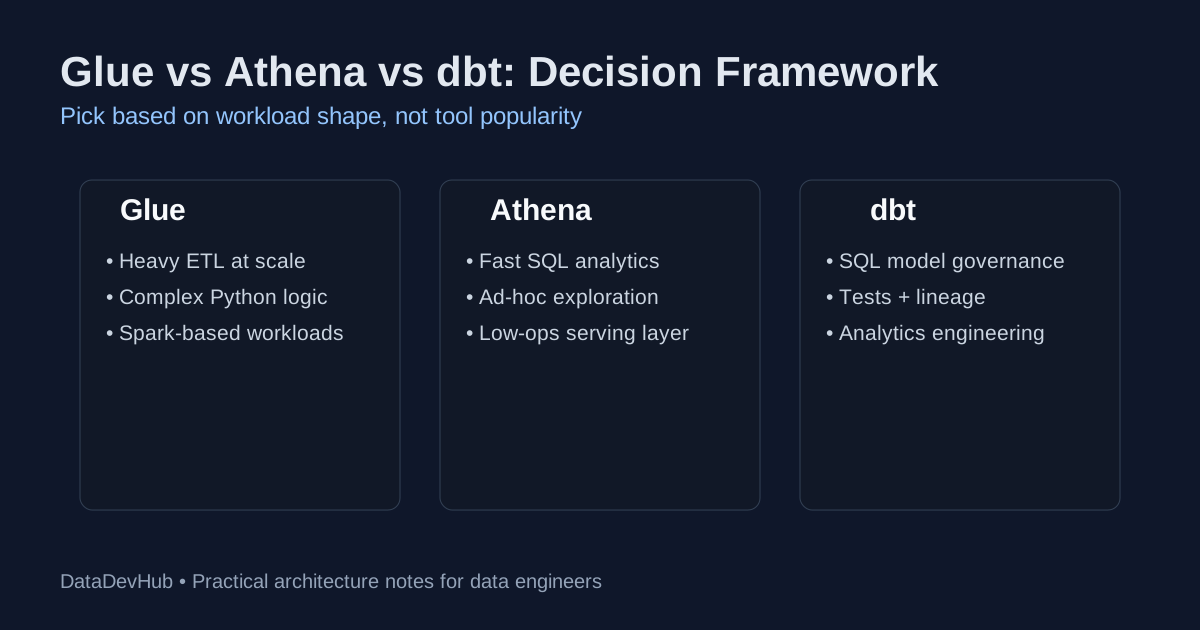
- Glue is best for heavy ETL and complex transformation logic at scale.
- Athena is best for SQL-first exploration and lightweight analytics transforms.
- dbt is best for model governance, testing, and semantic SQL layers.
In many production systems, all three are used together.
Start with workload shape
Before selecting tools, document:
- Daily data volume
- Transformation complexity
- Latency/freshness requirements
- Team skill profile (Python-heavy vs SQL-heavy)
- Reliability and testing requirements
Tool selection without this almost always leads to expensive rework.
When Glue is the right default
Choose Glue when you need:
- Spark-based processing across large datasets
- complex joins/enrichment with non-trivial logic
- Python transformations that are hard to express in SQL
- managed serverless ETL with AWS-native integration
Example Glue use case
- Raw clickstream + CRM + transactional data
- dedupe + sessionization + enrichment
- write to silver/curated partitioned data in Parquet
When Athena is enough
Athena works very well when:
- transformations are straightforward SQL
- data sits cleanly in S3 with strong partitioning
- you need low-ops ad hoc analytics and quick iteration
Athena can become expensive if file layout and partitioning are poor.
Example Athena use case
- lightweight derived reporting tables
- exploratory analytics for business teams
- periodic SQL jobs over curated datasets
Where dbt adds major value
dbt is less about compute and more about discipline:
- modular SQL model design
- tests for assumptions
- lineage and documentation
- repeatable analytics engineering workflows
If multiple people maintain SQL models, dbt usually pays for itself quickly.
Practical combination pattern
A pattern I recommend for many teams:
- Glue: heavy raw -> clean transforms
- dbt: clean -> curated semantic models
- Athena: query curated models for BI/ad hoc
flowchart LR
    A[Raw S3] --> B[Glue ETL]
    B --> C[Clean Layer]
    C --> D[dbt Models]
    D --> E[Curated Layer]
    E --> F[Athena Queries]
This keeps responsibilities clear and avoids one giant monolith.
Decision matrix (simple version)
| Requirement | Glue | Athena | dbt |
|---|---|---|---|
| Very large ETL | ✅ | ⚠️ | ❌ |
| Complex Python logic | ✅ | ❌ | ❌ |
| Fast SQL exploration | ⚠️ | ✅ | ⚠️ |
| SQL model governance | ❌ | ⚠️ | ✅ |
| Built-in lineage/docs | ❌ | ❌ | ✅ |
| Low-ops analytics querying | ⚠️ | ✅ | ⚠️ |
Legend: ✅ strong fit, ⚠️ possible with caveats, ❌ poor fit
Cost and operations considerations
Glue cost risks
- over-provisioned workers
- unnecessary wide shuffles
- repeated full reloads
Athena cost risks
- scanning unpartitioned data
- too many tiny files
- querying raw instead of curated layers
dbt cost risks
- over-materializing every model
- running full-refresh too often
Cost optimization is mostly architecture + data layout, not tool marketing.
Common anti-patterns
- Running all transformations in Athena over raw CSV forever
- Building everything in one huge Glue script with no modeling layer
- Using dbt but skipping tests and treating it as a SQL folder
- No clear owner for data model contracts
A migration note for GCP engineers
If you come from Dataflow/BigQuery/dbt workflows:
- don’t force 1:1 service mapping
- focus on pipeline shape and team operating model
- keep clean separation of transform, model, and serve layers
Final take
There is no universal winner between Glue, Athena, and dbt.
The best architecture is usually a purposeful combination:
- Glue for heavy lifting
- dbt for model quality and governance
- Athena for accessible query serving
In the next post, I’ll break down how to design a practical medallion lakehouse on AWS so these tools work together cleanly.