Feature-Ready Tables: Preparing Data for ML and GenAI Workloads
Many teams treat BI tables and AI feature datasets as separate worlds.
That creates duplicate pipelines, inconsistent definitions, and quality drift.
A better approach is to design feature-ready tables in your curated layer so they can be consumed by dashboards, batch ML, and GenAI retrieval pipelines.
What makes a table feature-ready?
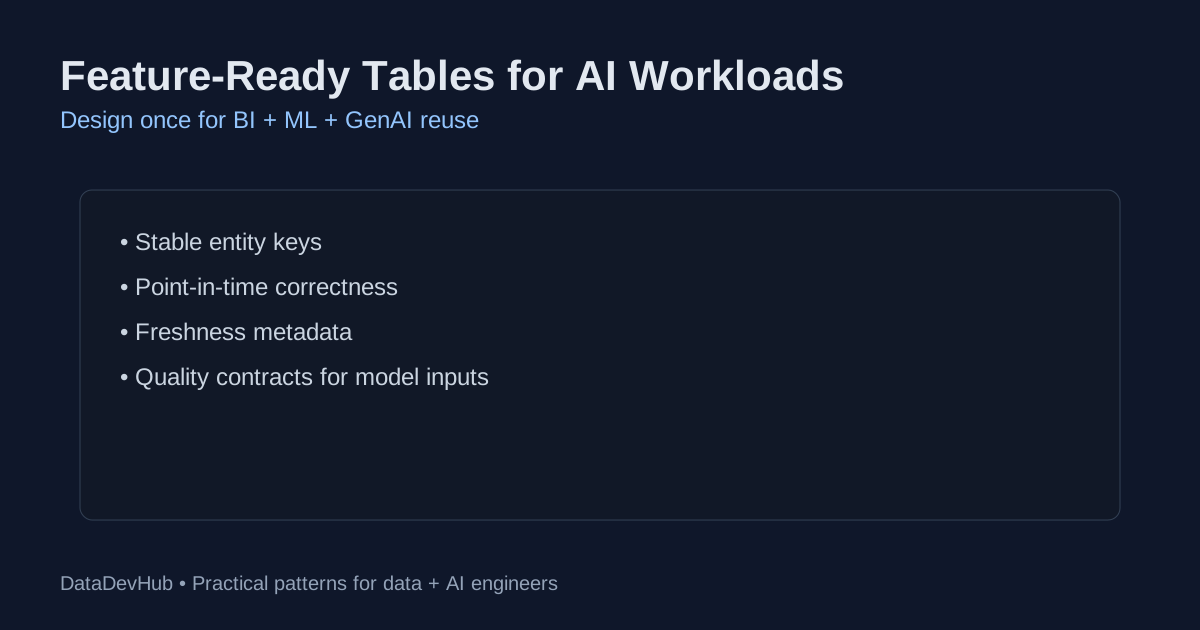
At minimum, feature-ready tables should provide:
- stable entity keys
- point-in-time correctness
- freshness metadata
- quality contract coverage
- clear ownership and lineage
Without these, model performance often fails silently in production.
Entity-first modeling
Start from business entities, not source schemas.
Examples:
- customer_profile_daily
- account_risk_features_daily
- product_engagement_features_hourly
This keeps feature design understandable and reusable.
Point-in-time correctness is non-negotiable
One of the biggest mistakes in feature pipelines is leakage.
If a feature includes data that wasn’t available at prediction time, offline metrics look great and production quality collapses.
Use event timestamps and partition windows carefully.
1
2
3
SELECT *
FROM gold.customer_features f
WHERE f.feature_date <= prediction_date;
Feature contracts
Define contracts for critical features:
- nullable behavior
- expected ranges
- freshness SLA
- deprecation policy
Contracts reduce surprises when upstream logic changes.
Serving patterns
A practical split:
- batch scoring features in parquet/iceberg tables
- near-real-time deltas in a low-latency serving layer
Don’t force one serving model for every use case.
Final take
Feature-ready tables are the bridge between data engineering and AI engineering.
If you design curated data with stable keys, quality, and temporal correctness, moving from analytics to AI products becomes much easier.