Data Contracts for Analytics Pipelines: A Practical Guide for Small Teams
Many pipeline incidents are not infrastructure failures.
They are expectation failures.
Example:
- producer changes a field type
- downstream SQL silently breaks
- dashboards and features become wrong before alerts trigger
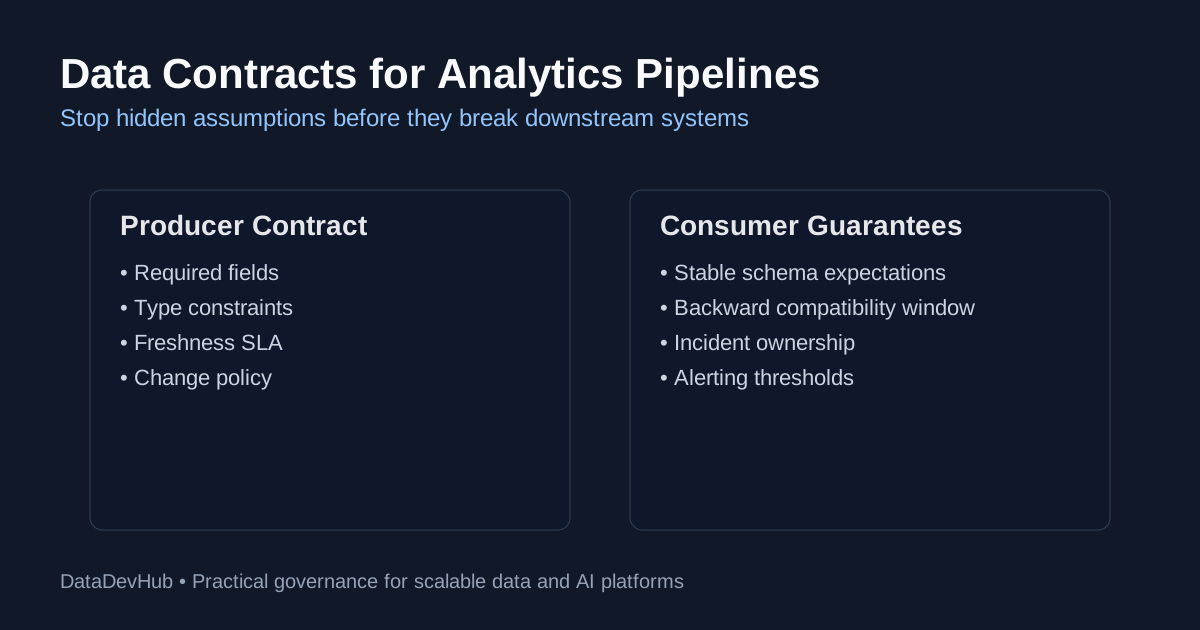
Data contracts help prevent this by making producer-consumer expectations explicit.
What is a practical data contract?
A practical contract is a lightweight agreement that defines:
- required fields
- data types and constraints
- freshness expectations
- acceptable change policy
- ownership and alerting path
It is not paperwork. It is executable alignment.
Why contracts matter even for small teams
Small teams often skip contracts because “we all know each other.”
This works until:
- team size grows
- one owner goes on leave
- new source system is added
- AI/analytics consumers increase
Contracts reduce hidden assumptions and onboarding friction.
Contract structure (minimal but useful)
A simple YAML contract can be enough:
1
2
3
4
5
6
7
8
9
10
11
12
13
14
15
16
17
18
dataset: orders_silver
owner: data-platform@company.com
freshness_sla: "daily by 07:00 AEST"
keys:
  primary: order_id
fields:
  - name: order_id
    type: string
    required: true
  - name: order_amount
    type: decimal(10,2)
    required: true
  - name: order_status
    type: string
    allowed_values: [pending, shipped, delivered, cancelled]
change_policy:
  backward_compatible_days: 14
  notify_channel: "#data-changes"
The goal is clarity, not perfect schema theory.
Where contracts should be enforced
Contract checks should run automatically in pipeline stages:
- On ingest (schema conformance)
- Before publish (critical field checks)
- On changes (breaking change detection)
If checks fail, publish should stop.
Contract checks example
1
2
3
4
5
6
SELECT
  SUM(CASE WHEN order_id IS NULL THEN 1 ELSE 0 END) AS null_order_id,
  SUM(CASE WHEN order_amount < 0 THEN 1 ELSE 0 END) AS invalid_amount,
  SUM(CASE WHEN order_status NOT IN ('pending','shipped','delivered','cancelled') THEN 1 ELSE 0 END) AS invalid_status
FROM silver.orders
WHERE dt = current_date - interval '1' day;
If any of these are non-zero above threshold, treat as contract failure.
Change policy patterns
Without a change policy, contracts become stale docs.
Use simple rules:
- additive fields: allowed
- type narrowing: blocked unless versioned
- field removals: deprecate first, remove after window
- notify consumers before breaking changes
This keeps evolution possible without constant breakage.
Data contracts and AI engineering
As teams add AI features, contracts become more important.
Why:
- embeddings and retrieval pipelines rely on stable fields
- feature pipelines need repeatable semantics
- evaluation datasets need consistent labels
A weak contract discipline in analytics usually becomes an AI reliability problem later.
Common mistakes
- writing contracts but not enforcing them
- making contracts too complex for current maturity
- no owner specified
- no change notification channel
Suggested rollout for your team
Week 1:
- pick top 3 critical datasets
- define minimal contracts
Week 2:
- add contract checks to orchestration
- block publish on hard failures
Week 3:
- define change policy and communication path
Week 4:
- track contract breach metrics and tune thresholds
Final take
Data contracts are one of the highest-ROI governance practices for modern data teams.
Start lightweight, enforce automatically, and evolve with your platform.
You don’t need enterprise bureaucracy to get enterprise reliability outcomes.